
Blog
How Is NLP Training Different From Therapy?
- June 16, 2026
- Posted by: Sitanshu
- Category: NLP Articles
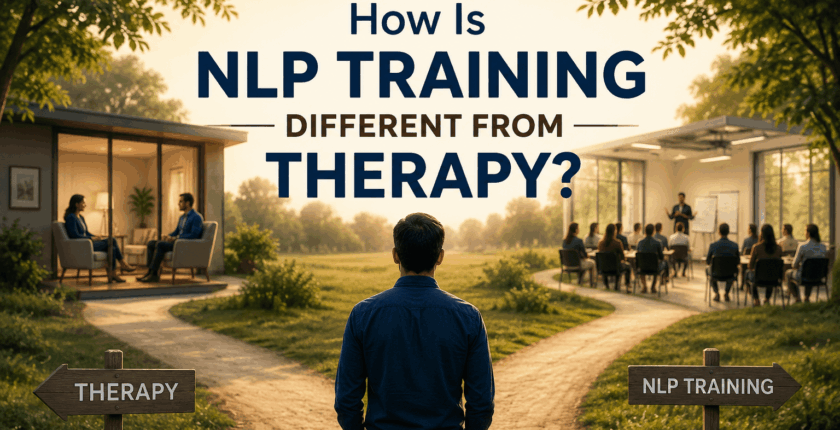
NLP Training vs Therapy: Understanding the Real Difference
One of the most common questions I get from people exploring personal development is:
“Should I go for NLP Training or should I book a therapy session?”
It’s a fair question.
After conducting NLP programs and working with participants for over 15 years, I’ve realized that many people see these two options as interchangeable. In reality, they serve very different purposes.
The confusion is understandable. Both involve personal growth. Both can help people overcome challenges. Both can lead to meaningful changes in life.
But the experience, the intention, and the outcome are often very different.
Let’s explore the difference.
Therapy and NLP Training Are Not Competing With Each Other
The first thing I’d like to clarify is that NLP Training and Therapy are not rivals.
In fact, there are situations where therapy may be the best place to start, and others where NLP training may provide broader value.
The question isn’t which one is better.
The question is:
“What do you need right now?”
Over the years, I have often had conversations with prospective participants unsure whether to attend an NLP Practitioner Program or seek one-on-one support.
The answer has never been the same for everyone.
-
When Therapy Is the Better Choice
In my experience, therapy is often the better option when someone is under significant emotional distress.
If a person is experiencing severe anxiety, carrying the weight of unresolved trauma, struggling to function in daily life, or feeling overwhelmed by their emotional state, they may not be in the best position to fully engage with a training program.
Training requires presence.
It requires focus, reflection, participation, and the ability to process new ideas.
When someone is fighting to stay emotionally afloat, expecting them to absorb a large amount of learning can sometimes be unrealistic.
In such situations, I have often recommended therapy first.
A skilled therapist can create a personalised process around the individual’s unique circumstances and provide support that is tailored to their immediate needs.
Sometimes the most helpful thing we can do is acknowledge that a person doesn’t need more information. They need support.
-
When NLP Training Becomes a Powerful Option
NLP Training tends to be valuable when someone wants to understand themselves better and develop practical tools they can use across different areas of life.
One of the biggest differences between therapy and training is scope.
Therapy often focuses on a specific challenge.
Training provides a toolkit.
Instead of working on one issue, participants learn a variety of models, frameworks, and techniques that can be applied to different situations over time.
This often leads to outcomes that people never expected when they first enrolled.
A Participant Who Came Looking for One Solution and Found Many
I remember speaking with a lady who was evaluating whether she should attend training or seek individual support.
She wanted to improve certain aspects of her life, including managing anxiety and building healthier relationships within her family.
After understanding her situation, we suggested that the NLP Practitioner Program might provide broader value because it would expose her to multiple tools and perspectives rather than focusing on a single issue.
She decided to join the program.
By the third day of the five-day training, she shared something that has stayed with me ever since.
She said that the program had already been worth every rupee she had invested.
What stood out wasn’t that one specific challenge had been solved.
What stood out was that she had discovered solutions to areas of her life she hadn’t even thought to address when she first walked into the room.
That is something I have witnessed repeatedly in NLP training.
People often arrive with one problem and leave with a completely different understanding of themselves.
The Young Man Who Came Looking for Goals
Another memorable example involved a young adult whose family wanted him to gain clarity about his future.
The initial thought was to arrange a one-on-one coaching intervention focused on goal setting.
Instead, we suggested the NLP Practitioner Program.
What happened over those five days surprised everyone involved.
The participant didn’t simply set goals.
He completely re-evaluated the direction he wanted his life to take.
He discovered a different path, developed greater clarity around what he wanted, and began creating a practical framework for achieving it.
The conversation had started with a question about goals.
It ended with a transformation in perspective.
That is one of the reasons I value training so highly.
Sometimes people don’t need answers.
Sometimes they need better questions.
The Biggest Misconception About NLP Training
One misconception I encounter frequently is that NLP is simply a collection of fancy ideas without substance.
I understand where that perception comes from.
Unlike many traditional disciplines, NLP often focuses more on results and application than on explaining every underlying mechanism in detail.
People naturally want to know exactly how something works.
NLP tends to focus more on what works and how to reproduce successful outcomes.
What has shaped my opinion is not theory alone.
It is observation.
Over the last fifteen years, I have seen people create meaningful shifts in their confidence, communication, relationships, emotional management, and decision-making.
Whether someone agrees with every aspect of NLP as a field is a separate discussion.
What continues to interest me is the practical impact it has had on the lives of many participants.

The Simplest Difference Between Therapy and NLP Training
If a friend asked me to explain the difference in a single conversation over coffee, I would probably say this:
Therapy is personalised support for a specific challenge. NLP Training teaches you a collection of tools that you can apply across multiple challenges.
In therapy, the professional guides the process and applies interventions based on your situation.
In training, you learn the models, frameworks, and techniques yourself.
You become the person using the tools.
Neither approach is inherently better.
They simply serve different purposes.
What Fifteen Years Have Taught Me About Change
Perhaps the most controversial opinion I have developed over the years is this:
Change does not always happen gradually.
We often hear that transformation takes time.
And sometimes it does.
But I have also witnessed people experience profound shifts in a single moment of realization.
I have seen participants decide to pursue a career they had been postponing for years.
I have seen people commit to relationships they had been avoiding.
I have seen people leave situations they knew were no longer serving them.
The external changes may unfold over weeks or months.
But the decision often happens instantly.
The realization happens instantly.
The perspective shifts instantly.
And once perspective changes, behaviour often follows.
The training itself may be part of a larger journey, but there are moments during that journey when everything suddenly makes sense.
Those moments are difficult to predict.
Yet they happen more often than most people realize.
So, Should You Choose Therapy or NLP Training?
If you are struggling with significant emotional distress, unresolved trauma, or challenges that require personalised support, therapy may be the right starting point.
If you are looking to develop practical tools, gain deeper self-awareness, improve communication, manage emotions more effectively, and create positive changes across multiple areas of life, NLP Training may offer tremendous value.
The choice isn’t about which path is superior.
It’s about choosing the path that best serves where you are today.
And sometimes, the most powerful transformation begins with asking the right question.
Explore our 5-day accredited NLP Practitioner Certification program to discover the tools, frameworks, and experiential learning process that have helped thousands of participants create meaningful personal and professional transformation.
Leave a Reply Cancel reply
This site uses Akismet to reduce spam. Learn how your comment data is processed.